
 Contacto
 Cómo comprar
Entrega
Guía de compras
 Inglés
 276 b
276 b
Hasta 30 días para devoluciones
Clientes que también han comprado









 binding.
 90.79
€
90.79
€






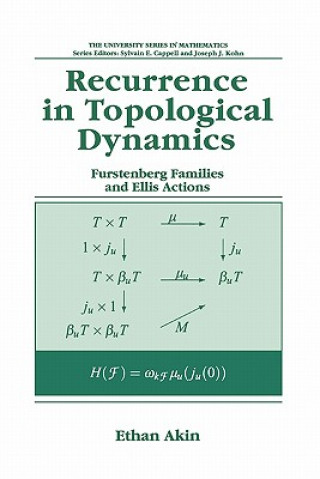
In the long run of a dynamical system, after transient phenomena have passed away, what remains is recurrence. An orbit is recurrent when it returns repeatedly to each neighborhood of its initial position. We can sharpen the concept by insisting that the returns occur with at least some prescribed frequency. For example, an orbit lies in some minimal subset if and only if it returns almost periodically to each neighborhood of the initial point. That is, each return time set is a so-called syndetic subset ofT= the positive reals (continuous time system) or T = the positive integers (discrete time system). This is a prototype for many of the results in this book. In particular, frequency is measured by membership in a family of subsets of the space modeling time, in this case the family of syndetic subsets of T. In applying dynamics to combinatorial number theory, Furstenberg introduced a large number of such families. Our first task is to describe explicitly the calculus of families implicit in Furstenberg's original work and in the results which have proliferated since. There are general constructions on families, e. g. , the dual of a family and the product of families. Other natural constructions arise from a topology or group action on the underlying set. The foundations are laid, in perhaps tedious detail, in Chapter 2. The family machinery is then applied in Chapters 3 and 4 to describe family versions of recurrence, topological transitivity, distality and rigidity.


Sobre el libro
Inglés
Categorías

Regale este libro hoy
Es fácil
1 Añadir al carrito y elegir Entregar como regalo en el checkout 2 Le enviaremos un vale 3 El libro llegará a la dirección del destinatarioTambién puede interesarle

 /
Tapa blanda
20.79
€
/
Tapa blanda
20.79
€
 /
Tapa blanda
22.79
€
/
Tapa blanda
22.79
€



 /
Tapa blanda
149.79
€
/
Tapa blanda
149.79
€


 /
Tapa blanda
22.99
€
/
Tapa blanda
22.99
€















¡Hola! Soy Libroamiko, tu asesor de libros.
¿Cómo puedo ayudarte?