
 Contacto
 Cómo comprar
Entrega
Guía de compras
 Inglés
 41 b
41 b
 Nuevo
Nuevo
Hasta 30 días para devoluciones

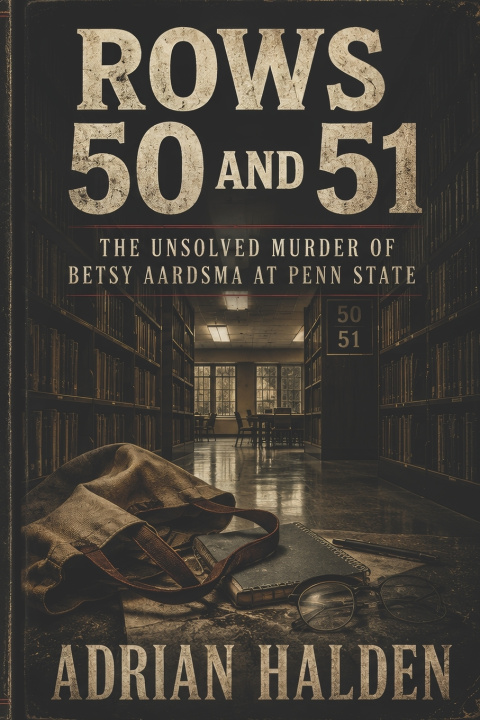
A young woman entered a university library to finish ordinary work. The record of her murder was damaged before anyone understood that a crime had occurred.
On November 28, 1969, twenty-two-year-old graduate student Betsy Aardsma was fatally stabbed inside Penn State's Pattee Library, between the rows that would become inseparable from her name. The wound was not immediately recognized, the scene was first treated as a medical emergency, and no one has been convicted of her murder. Rows 50 and 51 examines this historical true crime case without turning uncertainty into certainty.
The investigation begins with the first crucial mistake: interpretation. Betsy appeared to have collapsed. Her injury was concealed by clothing, the visible scene did not announce a stabbing, and people responded with the urgent intention to help. By the time the death was understood as a homicide, Betsy had been moved and the library space had continued to function. The book traces how those early minutes affected the preservation of the scene, the meaning of physical evidence, and every later attempt to reconstruct what happened.
From the narrow architecture of the stacks to reported witness fragments, possible exit routes, disputed blood evidence, missing objects, and the unrecovered weapon, the surviving record is examined by strength rather than drama. Confirmed facts remain separate from testimony, inference, rumor, and campus mythology. The result is not a manufactured solution, but a careful cold case investigation into what the evidence can support-and where it stops.
The book also considers the people and institutions drawn into the case: Betsy's family and academic life, the Pennsylvania State Police investigation, Penn State's response, later researchers, and the suspect theories that came to dominate public discussion. Serious suspicion is examined without being converted into a verdict. A plausible theory may explain part of the record, but it cannot replace a prosecution, a trial, or legally established responsibility.
As the years passed, the unsolved campus murder became a Penn State legend repeated through books, articles, podcasts, and student memory. Rows 50 and 51 explores how public retellings can preserve attention while also hardening uncertain details into accepted story. It asks what is lost when a victim becomes a symbol, when an institution's silence becomes a blank space for speculation, and when the most complete narrative begins to feel more proven than it is.
Written in a restrained, victim-centered, evidence-aware style, this true crime nonfiction book is for readers interested in historical cold cases, unsolved murders, crime scene failures, witness evidence, institutional memory, and the ethics of writing about real victims. It returns repeatedly to Betsy Aardsma as a person whose life was larger than the location where it ended.
This is a study of a damaged record, a case that still refuses legal closure, and the discipline required to remember without pretending to know more than the evidence allows.


Sobre el libro
Inglés

Regale este libro hoy
Es fácil
1 Añadir al carrito y elegir Entregar como regalo en el checkout 2 Le enviaremos un vale 3 El libro llegará a la dirección del destinatario¡Hola! Soy Libroamiko, tu asesor de libros.
¿Cómo puedo ayudarte?