
 Contacto
 Cómo comprar
Entrega
Guía de compras
Saussure
 Francés
 65 b
65 b
Política de devolución de 30 días
Clientes que también han comprado




 /
/
 Tapa blanda
 49.19
€
49.19
€










 /
Tapa dura
136.59
€
/
Tapa dura
136.59
€

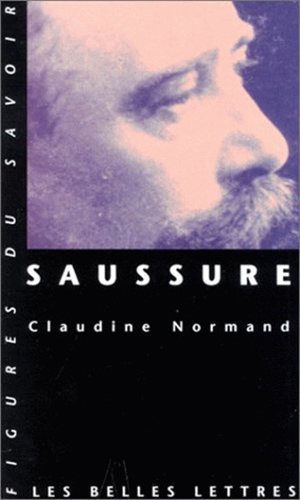
Ferdinand de Saussure (1857-1913), who was born into a family of Genevan scholars, was, interested in language studies from an early age (his Essai sur les langues dates from 1872). He was the first to assign a specific purpose to linguistics, language (as opposed to speech) and a space-time concept in which it could be rigorously studied, synchrony (as opposed to diachrony). His teachings have been essentially passed on to us in the form of a Course that was never considered as such, published after his death. That text, Cours de linguistique générale (Course in General Linguistics) which considerably influenced the field of linguistics and other disciplines (Lévi-Strauss, Lacan and Barthes, among others, were inspired by it) deserves to be read on the basis of its own merits, now that the " structuralist " fever of the 1970s has abated. This book presents the concepts that established Saussure's reputation, his thesis on the arbitrary nature of signs, in particular. It begins by showing that this thesis is related to Saussure's primary innovation : semiology (the science of linguistic, and non-linguistic, signs), and then examines the questions and controversies immediately raised by the Course. Here, the author bases her findings on the most recently discovered handwritten manuscripts. She thereby hopes to prove that the linguistic and philosophical questions raised by the Cours de linguistique générale are as relevant today as they have ever been.Claudine Normand, a senior lecturer in linguistics, wrote the distinguished published work, Métaphore et concept (1978), and co-directed the 1992 Cerisy-la-Salle symposium " Saussure aujourd'hui " [" Saussure Today "].


Sobre el libro
Francés
Categorías

Regale este libro hoy
Es fácil
1 Añadir al carrito y elegir Entregar como regalo en el checkout 2 Le enviaremos un vale 3 El libro llegará a la dirección del destinatarioTambién puede interesarle

¡Hola! Soy Libroamiko, tu asesor de libros.
¿Cómo puedo ayudarte?