
 Contacto
 Cómo comprar
Entrega
Guía de compras
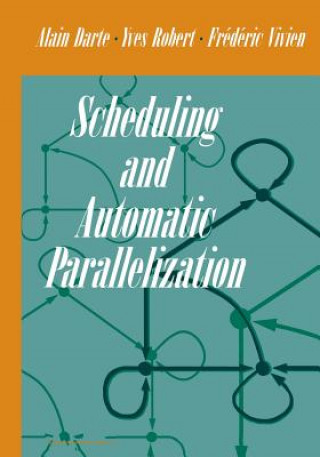
Scheduling and Automatic Parallelization, 1
 Inglés
 276 b
276 b
Política de devolución de 30 días
Clientes que también han comprado












 /
/
 Tapa blanda
 20.09
€
20.09
€

 /
Tapa blanda
37.49
€
/
Tapa blanda
37.49
€



 /
Tapa blanda
58.09
€
/
Tapa blanda
58.09
€




Readership This book is devoted to the study of compiler transformations that are needed to expose the parallelism hiddenin a program. This book is notan introductory book to parallel processing, nor is it an introductory book to parallelizing compilers. Weassume thatreaders are familiar withthebooks High Performance Compilers for Parallel Computingby Wolfe [121] and Super compilers for Parallel and Vector Computers by Zima and Chapman [125], and that they want to know more about scheduling transformations. In this book we describe both task graph scheduling and loop nest scheduling. Taskgraphschedulingaims atexecuting tasks linked by prece dence constraints; it is a run-time activity. Loop nest scheduling aims at ex ecutingstatementinstances linked bydata dependences;it is a compile-time activity. We are mostly interested in loop nestscheduling,butwe also deal with task graph scheduling for two main reasons: (i) Beautiful algorithms and heuristics have been reported in the literature recently; and (ii) Several graphscheduling, like list scheduling, are the basis techniques used in task ofthe loop transformations implemented in loop nest scheduling. As for loop nest scheduling our goal is to capture in a single place the fantastic developments of the last decade or so. Dozens of loop trans formations have been introduced (loop interchange, skewing, fusion, dis tribution, etc.) before a unifying theory emerged. The theory builds upon the pioneering papers of Karp, Miller, and Winograd [65] and of Lam port [75], and it relies on sophisticated mathematical tools (unimodular transformations, parametric integer linear programming, Hermite decom position, Smithdecomposition, etc.).


Sobre el libro
Inglés

Regale este libro hoy
Es fácil
1 Añadir al carrito y elegir Entregar como regalo en el checkout 2 Le enviaremos un vale 3 El libro llegará a la dirección del destinatarioTambién puede interesarle
 /
Tapa dura
236.39
€
/
Tapa dura
236.39
€








 /
Tapa blanda
17.19
€
/
Tapa blanda
17.19
€








 /
Tapa blanda
22.89
€
/
Tapa blanda
22.89
€



¡Hola! Soy Libroamiko, tu asesor de libros.
¿Cómo puedo ayudarte?