
 Contacto
 Cómo comprar
Entrega
Guía de compras
Science before Socrates
 Inglés
 296 b
296 b
Hasta 30 días para devoluciones
Clientes que también han comprado













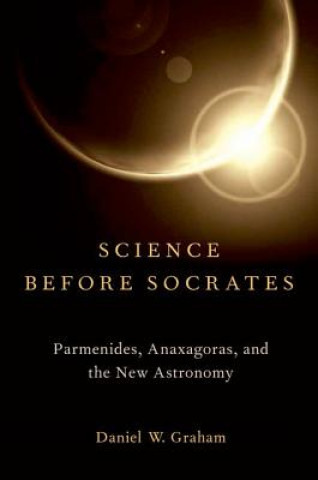
In Science before Socrates, Daniel Graham argues against the prevalent belief that the Presocratic philosophers did not produce any empirical science and that the first major Greek science, astronomy, did not develop until at least the time of Plato. Instead, Graham proposes that the advances made by Presocratic philosophers in the study of astronomy deserve to be considered as scientific contributions. Whereas philosophers of the sixth century BC treated astronomical phenomena as ephemeral events continuous with weather processes, those of the fifth century treated heavenly bodies as independent stony masses whirled in a cosmic vortex. Two historic events help to date and account for the change: a solar eclipse in 478 BC and a meteoroid that fell to earth around 466. Both events influenced Anaxagoras, who transformed insights from Parmenides into explanations of lunar and solar eclipses, meteors, and rainbows. Virtually all philosophers came to accept Anaxagoras' theory of lunar light and eclipses. Aristotle endorsed Anaxagoras' theory of eclipses as a paradigm of scientific explanation. Anaxagoras' theories launched a geometrical approach to astronomy and were accepted as foundational principles by all mathematical astronomers from Aristarchus to Ptolemy to Copernicus and Galileo-and to the present day.


Sobre el libro
Inglés

Regale este libro hoy
Es fácil
1 Añadir al carrito y elegir Entregar como regalo en el checkout 2 Le enviaremos un vale 3 El libro llegará a la dirección del destinatarioTambién puede interesarle









 /
/
 Tapa blanda
 18.69
€
18.69
€










¡Hola! Soy Libroamiko, tu asesor de libros.
¿Cómo puedo ayudarte?