
 Contacto
 Cómo comprar
Entrega
Guía de compras
 Inglés
 54 b
54 b
Política de devolución de 30 días

"This book is intended as a self-help guide to working with the kinds of difficulties that move people to seek counselling help. I had to think hard about whether it should be the sort of self-help book that simply makes suggestions for what one can usefully do on one's own, or whether it should also explain what lies behind the suggestions. Although the book forms, I hope, a fairly unified whole, it should be possible for someone to ignore the parts that involve the wider context, explanations and theory, if they are simply seeking a self-help manual. The part of the book that fulfils that function is contained in Chapters 2 - 4, or for the bare essentials, just Chapters 2 and 3. Chapter 4 looks at some elaborations of the basic principles, and at some difficulties that can arise. Chapter 5 explores special issues around trauma and Chapter 6 discusses 'mood disorders' such as anxiety and depression. Chapter 7 looks beyond self-reflection to making changes in one's life, and also beyond therapy to issues that we might think of as 'spiritual' rather than 'psychological'. Finally, in Chapter 8 I reflect in a more philosophical way on how Focusing works.
...
Focusing is not well understood as a 'technique'. Rather, it makes explicit 0a way in which reflection on our difficulties can be especially effective. It is something that many people do naturally at times, but it does need to be distinguished from other things we can do, such as 'thinking logically about our problems', or 'noticing our feelings', or 'accessing our emotions', or 'becoming aware of our bodily sensations'. These can all be helpful in therapy, but they are not Focusing.
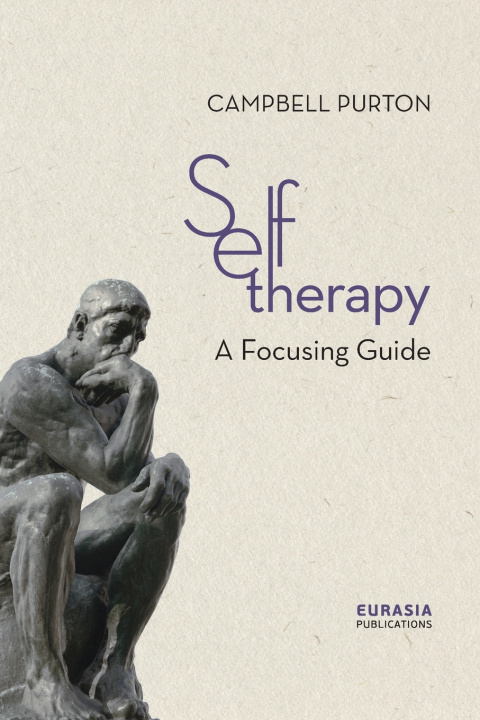
Focusing is a way of giving sustained attention to our trouble in a way that leads to steps of change. As I'll explain in more detail later, it involves taking time to attend to a troubling situation as a whole. It is a kind of reflecting, but is not so much a matter of logical thought, as of pondering (dwelling on, contemplating, weighing up, chewing over) one's situation. It involves concentrated attention of the sort that is portrayed in Rodin's sculpture 'The Thinker', originally known as 'The Poet'. Focusing is more like finding the right words when writing a poem than getting the right answer to a calculation: it involves moving back and forth between one's sense of the problem as a whole, and the intimations or 'hints' that may then come to us, and which step by step may lead to the resolution of the difficulty.
...
Focusing can involve attending to emotions, thoughts, behaviour, but none of these is central to it. What is central, as I'll be explaining, is something less familiar, something more like our inklings or intimations of what our difficulty is really all about. It is concerned with things that we feel but can't yet express. Gendlin called this sort of feeling a 'felt sense' of something. It is not so much a feeling of what is there, but of what could be there, of what needs to be there, or of what is 'on its way'. Focusing works at the 'edge' between what we clearly know and what we don't yet know, but staying at this 'edge' can take some practice.
...
I have found Focusing to be very helpful in working with clients, and in my own life, and this has led me to investigate more thoroughly how it works, and how it relates to other approaches to therapy. It can be used by itself, and this book will be mainly concerned with that".
Campbell Purton, from the book's introduction


Sobre el libro
Inglés

Regale este libro hoy
Es fácil
1 Añadir al carrito y elegir Entregar como regalo en el checkout 2 Le enviaremos un vale 3 El libro llegará a la dirección del destinatario¡Hola! Soy Libroamiko, tu asesor de libros.
¿Cómo puedo ayudarte?