Envío gratis a partir de 69,99 euros.

Entre a formar parte de una comunidad de amantes de los libros del mundo entero y acceda a un sinfín de ventajas.
Crear una cuenta gratis
Envío gratuito con Zásilkovna para compras superiores a 59.99 €
Mensajería SEUR 4.99 €
Mensajería GLS 7.99 €
Mensajería Correos 5.49 €
Mensajería DHL 5.49 €
Punto SEUR 3.99 €
 Contacto
 Cómo comprar
Ayuda
Entrega
Mensajería SEUR 4.99 €
Mensajería GLS 7.99 €
Mensajería Correos 5.49 €
Mensajería DHL 5.49 €
Punto SEUR 3.99 €
Envío gratuito con Zásilkovna para compras superiores a 59.99 €
Guía de compras
Mi cuenta
▸
Vacío :-(
0
Envío gratis a partir de 69,99 euros.
Idioma
 Inglés
Inglés
Libro
Tapa blanda
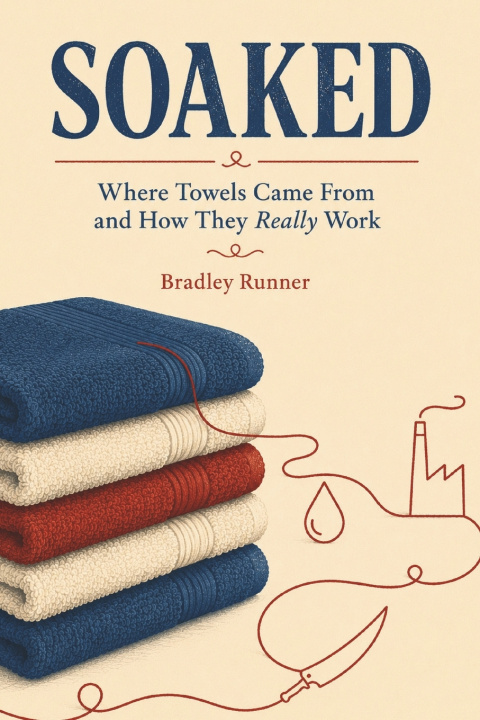
Every mammal shakes itself dry. Humans have to go find equipment.Nobody thinks about towels. That tu...
Descripción completa
Código Libristo: 53491737
?
 36 b
36 b
 Próximamente
 Nuevo
Nuevo
36 b
Próximamente
Nuevo
14.59
€
Reaprovisionamiento previsto
Lanzamiento 12. 08. 2026
Hasta 30 días para devoluciones

Every mammal shakes itself dry. Humans have to go find equipment.
Nobody thinks about towels. That turns out to be a mistake.
The thick, looped towel hanging in your bathroom is younger than the camera, younger than the bicycle, and younger than baseball - even though people have been getting wet, and needing to get dry, for the whole of human history. Why did it take so long? And what is actually happening in that piece of cotton when it pulls water out of your skin, uphill, against gravity?
SOAKED follows one ordinary object across two hundred thousand years, and the places it goes are not ordinary at all:
- Greek athletes who scraped themselves clean with bronze blades - and sold the scrapings
- The Ottoman workshop where someone first pulled a loop of thread up out of a flat weave
- A boy who started factory work at seven and built the machine that changed everything
- The American mill owner who invented the idea that a towel could have a name on it
- The year a state government declared towels a public health hazard - and the laws still on the books today
- Medical professors who spent eighteen months sneaking into restaurant washrooms with briefcases
- The company caught selling three-quarters of a million bedsheets made of the wrong cotton
- And a very large lake that is not there anymore
Along the way, real science explained clearly: capillary action, why cotton grabs water and plastic doesn't, why a brand-new towel repels water, why fabric softener quietly wrecks absorbency, why line-dried towels come out stiff - and why the crunchy one is usually the better one.
Five hands-on experiments let readers test every claim themselves, including one that deliberately ruins a towel to prove a point, and one that builds a working model of an 1848 weaving machine out of cardboard and yarn.
And running underneath all of it is something more valuable than any single fact: this book stops and checks its own stories. When the famous version turns out to be wrong, it says so and shows the reader exactly how to tell. A dated letter that catches a beloved anecdote running backwards. A statistic nobody has ever sourced. A figure published anywhere from 120 to 18 million. Young readers finish this book knowing how to ask who says so, and how would they know?
Written for curious readers aged 8 to 11 - and for the adults who will end up reading it over their shoulder.
From the author of SCRUBBED: Where Soap Came From and How It Really Works and FOR WHAT IT'S WORTH: Where Recycling Came From and How It Really Works.
Actriz
&
Políglota
EWA KASP
para
Visualizar el vídeo


Libristo tiene la oferta más extensa de literatura en idiomas extranjeros. Por eso compran aquí sus libros.
Sobre el libro
Nombre y apellidos
Soaked
Autor
Bradley Runner
Idioma
Inglés
Inglés
Encuadernación
Libro - Tapa blanda
Fecha de publicación
2026
Número de páginas
150
EAN
9798189968259
Código Libristo
53491737
Editores
Independently published
Peso
192
Dimensiones
152 x 229 x 10
Categorías
Sociedad y ciencias sociales
>
Psicología
>
Teoría, sistemas, puntos de vista y escuelas psicológicas
>
Teoría conductista (conductismo)

Regale este libro hoy
Es fácil
1 Añadir al carrito y elegir Entregar como regalo en el checkout 2 Le enviaremos un vale 3 El libro llegará a la dirección del destinatario
Asesor de libros Libroamiko
Al usar este chat, te estás comunicando con inteligencia artificial generativa. Al usarlo, también aceptas el tratamiento de datos personales.
¡Hola! Soy Libroamiko, tu asesor de libros.
¿Cómo puedo ayudarte?
Hola, soy Libroamiko, ¿puedo ayudarte?