
 Contacto
 Cómo comprar
Entrega
Guía de compras
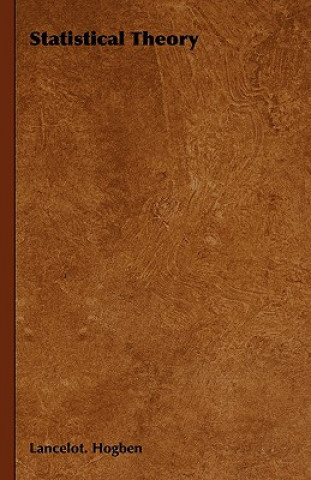
Statistical Theory
 Inglés
 109 b
109 b
Hasta 30 días para devoluciones
Clientes que también han comprado


 /
/
 Tapa blanda
 37.49
€
37.49
€



 /
Tapa blanda
15.99
€
/
Tapa blanda
15.99
€



 /
Tapa blanda
91.19
€
/
Tapa blanda
91.19
€



 /
Tapa blanda
23.89
€
/
Tapa blanda
23.89
€









STATISTICAL THEORY The Relationship of Probability Credibility and. Error by LANCELOT HOGBEN.CONTENTS: Foreword page 7 1 The Contemporary Crisis or the Uncertainties of Uncertain Inference 13 PART I. THE FOUNDING FATHERS 2 The Founding Fathers and the Natural History of Gambling 33 3 Randomness and the Relevance of the Rule 59 4 Division of the Stakes and the Lottery of Life and Death 83 5 The Backward Look and the Balance Sheet of Thomas Bayes no 6 The Place of Laplace and the Grand Climacteric of the Classical Tradition 133 PART II. THE CALCULUS OF ERROR AND THE CALCULUS OF EXPLORATION 7 The Normal Law comes into the Picture 159 8 The Method of Least Squares and the Concept of Point Estimation 182 9 Error, Variation and Natural Law 210 10 Stochastic Models for Simple Regression 232 11 The Impasse of Factor Analysis 257 PART III. THE CALCULUS OF AGGREGATES 12 Maxwell and the Urn of Mature 279 13 Mendelism and the Two Meanings of Probability 297 PART IV. THE CALCULUS OF JUDGMENTS 14 Statistical Prudence and Statistical Inference 319 1 5 Decision Indecision and Sample Economy 345 1 6 Induction and Design, Stochastic and Non-stochastic 370 1 7 Recipe and Rule in Stochastic Induction 399 1 8 The Confidence Controversy and the Fifth Canon 433 1 9 Epilogue 454 Appendix I 477 Appendix II 480 Appendix III 485 Appendix IV 7 Index 07. FOREWORD: THE USE of the word behaviourist in my sub-title calls for clarification. It came into current usage chiefly through the writings of J. B. Watson, in the first fine flush of enthusiasm following the reception of Pavlovs work on conditioned reflexes. Watson conveyed the impression that all forms of animal including human behaviour are ultimately explicable in terms of neural or humoral co-ordination of receptors and effectors. Neither this proposition nor its denial is susceptible of proof. A comet may destroy the earth before we have completed a research programme of such magnitude as the operative adverb ultimately suggests. Many years ago, and in what now seems to me a very im mature volume of essays written as a counter-irritant to the mystique of Eddingtons Nature of the Physical World, I suggested a more restricted definition of the term and offered an alter native which seemingly did not commend itself to my con temporaries. By behaviourist in this context I mean what Ryle means in the concluding section of his recent book The Concept of Mind. What Ryle speaks of as the behaviourist viewpoint and what I had previously preferred to call the publicist outlook has no concern with structure and mechanism. Our common approach to the problem of cognition is not at the ontological level. The class of questions we regard as profitable topics of enquiry in this context arise at the level of epistemology, or, better still, what G. P. Meredith calls epistemics. If one wishes to discuss with any hope of reaching agreement what one means by knowledge or preferably knowing the two main topics of the agenda for our public symposium will be recognition and communication and we shall discuss them as different facets of the same problem, neither meaningful in isolation. A simple illustration will suffice to make clear, both at the emotive level of non-communicable private conviction and at the public or communicable level of observable be haviour, the difference between knowing, conceived as a process, and knowledge, conceived as a static repository. The Nature of Living Matter 1930. 7 STATISTICAL THEORY We shall suppose that B is colour-blind to differences in the red and green regions of the visible spectrum, A being normal in the customary sense of the term in the relevant context...


Sobre el libro
Inglés
Categorías

Regale este libro hoy
Es fácil
1 Añadir al carrito y elegir Entregar como regalo en el checkout 2 Le enviaremos un vale 3 El libro llegará a la dirección del destinatarioTambién puede interesarle







 /
Tapa blanda
8.99
€
/
Tapa blanda
8.99
€
 /
Tapa blanda
13.49
€
/
Tapa blanda
13.49
€
 /
Tapa blanda
33.69
€
/
Tapa blanda
33.69
€


 /
Tapa blanda
45.79
€
/
Tapa blanda
45.79
€





¡Hola! Soy Libroamiko, tu asesor de libros.
¿Cómo puedo ayudarte?