
 Contacto
 Cómo comprar
Entrega
Guía de compras
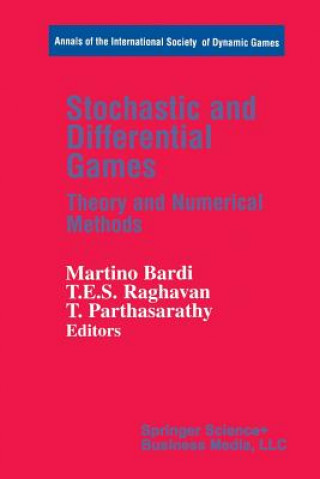
Stochastic and Differential Games, 1
Theory and Numerical Methods
 Inglés
 249 b
249 b
Hasta 30 días para devoluciones
Clientes que también han comprado

 /
/
 Tapa dura
 32.79
€
32.79
€
 Tapa blanda
17.49
€
Tapa blanda
17.49
€

 /
Tapa blanda
15.09
€
/
Tapa blanda
15.09
€









 /
Tapa blanda
11.49
€
/
Tapa blanda
11.49
€


















The theory of two-person, zero-sum differential games started at the be ginning of the 1960s with the works of R. Isaacs in the United States and L. S. Pontryagin and his school in the former Soviet Union. Isaacs based his work on the Dynamic Programming method. He analyzed many special cases of the partial differential equation now called Hamilton Jacobi-Isaacs-briefiy HJI-trying to solve them explicitly and synthe sizing optimal feedbacks from the solution. He began a study of singular surfaces that was continued mainly by J. Breakwell and P. Bernhard and led to the explicit solution of some low-dimensional but highly nontriv ial games; a recent survey of this theory can be found in the book by J. Lewin entitled Differential Games (Springer, 1994). Since the early stages of the theory, several authors worked on making the notion of value of a differential game precise and providing a rigorous derivation of the HJI equation, which does not have a classical solution in most cases; we mention here the works of W. Fleming, A. Friedman (see his book, Differential Games, Wiley, 1971), P. P. Varaiya, E. Roxin, R. J. Elliott and N. J. Kalton, N. N. Krasovskii, and A. I. Subbotin (see their book Po sitional Differential Games, Nauka, 1974, and Springer, 1988), and L. D. Berkovitz. A major breakthrough was the introduction in the 1980s of two new notions of generalized solution for Hamilton-Jacobi equations, namely, viscosity solutions, by M. G. Crandall and P. -L.


Sobre el libro
Inglés

Regale este libro hoy
Es fácil
1 Añadir al carrito y elegir Entregar como regalo en el checkout 2 Le enviaremos un vale 3 El libro llegará a la dirección del destinatarioTambién puede interesarle

 /
Tapa dura
1 421.69
€
/
Tapa dura
1 421.69
€
 /
Tapa blanda
14.29
€
/
Tapa blanda
14.29
€
 /
Tapa dura
30.79
€
/
Tapa dura
30.79
€
 /
Tapa blanda
27.89
€
/
Tapa blanda
27.89
€











 /
Tapa blanda
18.09
€
/
Tapa blanda
18.09
€






 /
Tapa blanda
9.79
€
/
Tapa blanda
9.79
€
¡Hola! Soy Libroamiko, tu asesor de libros.
¿Cómo puedo ayudarte?