
 Contacto
 Cómo comprar
Entrega
Guía de compras
Surface Pressure Prediction in High-Speed Flows
 Inglés
 46 b
46 b
 Próximamente
 Nuevo
Nuevo
Hasta 30 días para devoluciones

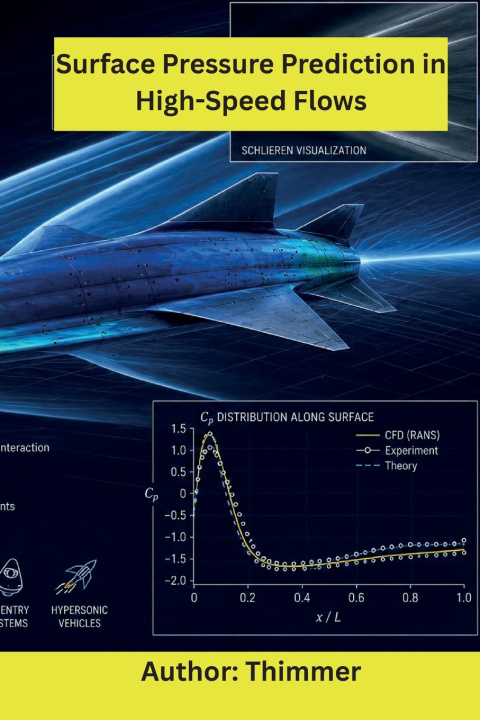
The prediction and analysis of surface pressure in high-speed flows are important aspects of modern fluid mechanics, aerodynamics, and aerospace engineering. When a fluid moves at high velocity around an aerodynamic body, variations in pressure, density, temperature, and velocity can produce complex flow behavior that directly influences aerodynamic forces and overall system performance. Surface Pressure Prediction in High-Speed Flows provides a focused introduction to the engineering principles and analytical approaches used to understand and predict pressure distributions on surfaces exposed to high-speed fluid flow.
The book examines the fundamental concepts of compressible fluid mechanics and high-speed aerodynamics, establishing the relationship between flow velocity, pressure, density, temperature, and Mach number. Readers are introduced to the characteristics of subsonic, transonic, and supersonic flow regimes and the physical phenomena that can influence surface pressure. These foundations provide the necessary context for understanding how aerodynamic pressure develops around bodies operating under different high-speed flow conditions.
A central focus is placed on surface pressure prediction and the engineering factors that determine pressure distributions. The discussion considers aerodynamic geometry, boundary conditions, flow properties, Mach number, shock waves, expansion effects, flow separation, and surface interactions. Readers gain an understanding of how changes in aerodynamic conditions can alter local pressure and contribute to overall aerodynamic loading.
The book also introduces computational and analytical approaches for evaluating high-speed flow behavior. Concepts associated with computational fluid dynamics, numerical flow analysis, aerodynamic modeling, pressure coefficient, flow-field prediction, and performance evaluation are considered within the broader framework of high-speed aerodynamics. These methods provide useful tools for studying complex flow behavior and developing predictions of surface pressure without relying on a particular commercial software platform or proprietary computational system.


Sobre el libro
Inglés

Regale este libro hoy
Es fácil
1 Añadir al carrito y elegir Entregar como regalo en el checkout 2 Le enviaremos un vale 3 El libro llegará a la dirección del destinatario¡Hola! Soy Libroamiko, tu asesor de libros.
¿Cómo puedo ayudarte?