
 Contacto
 Cómo comprar
Entrega
Guía de compras
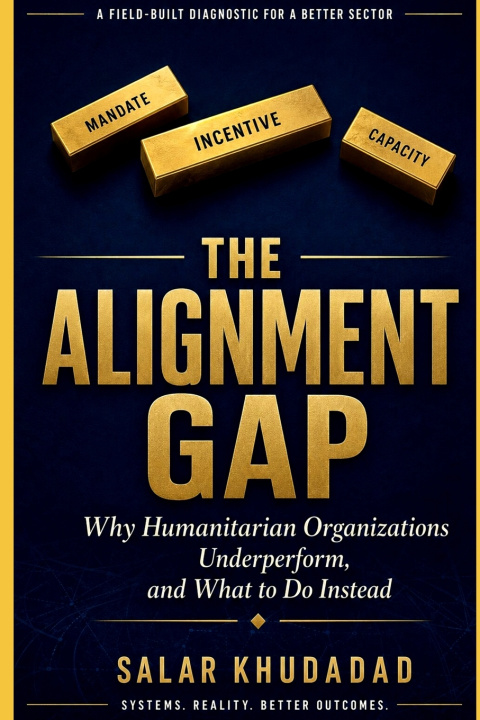
THE ALIGNMENT GAP
Why Humanitarian Organizations Underperform, and What to Do Instead
 Inglés
 35 b
35 b
 Próximamente
 Nuevo
Nuevo
Hasta 30 días para devoluciones

Humanitarian organizations are not failing for the reasons they usually blame.
Not funding. Not donor politics. Not host governments. Those constraints are real, but they are not the whole story. The bigger, quieter problem sits inside the organizations themselves: in the layered approval chains, the disconnected program-operations-advocacy silos, the risk management built for headquarters rather than the field, and the monitoring systems designed to satisfy donors rather than help anyone learn.
The Alignment Gap is built on Mandate, Incentive, and Capacity Alignment, a way of reading organisational failure I developed over fifteen years working in field and headquarters roles across Iraq, Sudan, and the wider region. Every humanitarian organisation runs on three things: what it says it exists to do, what it actually rewards, and what its systems can actually deliver. When these fall out of alignment, the organisation underperforms its own mission, no matter how much money it raises or how good its people are. This book is my own analysis of exactly where that gap opens and why, not a management theory borrowed from a business school, but a way of looking built from watching the same failure pattern recur, response after response, country after country.
Each chapter takes one recurring failure point, bureaucratic layering, program-operations-advocacy silos, headquarters-field risk mismatches, compliance-driven MEAL systems, staffing and handover gaps, imbalanced local partnerships, donor-driven funding architecture, and leadership dependent on individuals rather than systems, and traces it from cause to cost to fix, tagging exactly which two of the three, mandate, incentive, capacity, are pulling apart in each case.
Inside, you'll find:
- Mandate, Incentive, and Capacity Alignment: a working way to locate exactly where an organisation's stated mission, its actual incentives, and its real capacity have come apart
- Eight recurring failure patterns, each traced from cause to cost to fix, with a named diagnosis for every one
- Anonymised composite cases drawn from years of field and headquarters experience
- A one-page quick-reference guide: the single highest-leverage fix for each pattern, built to hold up against your own organisation without rereading the whole book
Written for senior managers, country directors, program managers, MEAL officers, HR and operations leads, and anyone inside an INGO, UN agency, or donor institution who has ever wondered why the mission and the org chart don't seem to agree.
Salar Khudadad has spent over fifteen years in field, country, and headquarter roles across Iraq, Sudan, and the wider MENA region, with organisations including WFP, OCHA, Save the Children International, MSF, and NGO Coordination Forum. He is the author of several practitioner books and a contributor to the Handbook on Humanitarian Crises (Edward Elgar Publishing, 2025).


Sobre el libro
Inglés
Categorías

Regale este libro hoy
Es fácil
1 Añadir al carrito y elegir Entregar como regalo en el checkout 2 Le enviaremos un vale 3 El libro llegará a la dirección del destinatario¡Hola! Soy Libroamiko, tu asesor de libros.
¿Cómo puedo ayudarte?