
 Contacto
 Cómo comprar
Entrega
Guía de compras
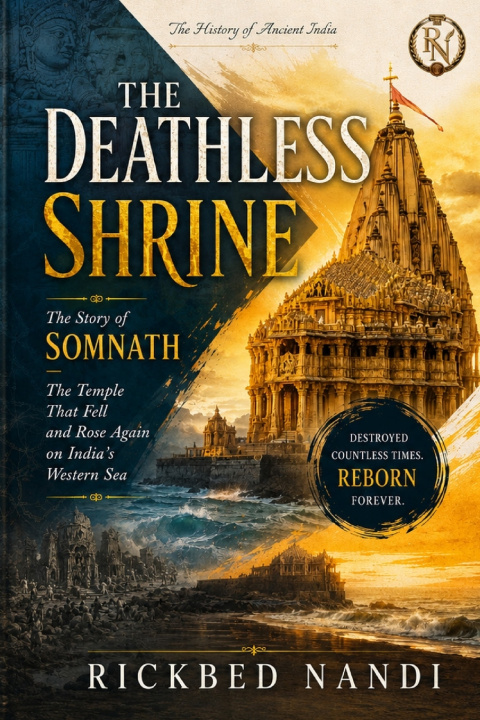
THE DEATHLESS SHRINE
The Story of Somnath - The Temple That Fell and Rose Again on India's Western Sea
 Inglés
 44 b
44 b
 Nuevo
Nuevo
Hasta 30 días para devoluciones

A Note to Readers
This is a book about a building that has been destroyed, by the most generous count, six times, and that has risen, by the same count, seven. It is therefore a book less about stone than about the strange human refusal to let a sacred place stay dead. The temple at the centre of this story stands at Prabhas Patan, on the southern tip of the Saurashtra peninsula in Gujarat, where the land of India runs out and the Arabian Sea begins. Its name is Somnath - the Lord of the Moon - and for at least a thousand years it has been one of the most contested patches of ground on the subcontinent.
I have tried to write the whole of its history, from the myths that gather around its origins to the December morning in 1995 when the last finial of its modern reconstruction was consecrated. That is an immense span, and the reader is owed some honesty at the outset about what can and cannot be known across it.
Much of what is told about Somnath is not history in the strict sense. It is memory, legend, devotion, and - it must be said plainly - propaganda, of several competing kinds. The story of the Moon god cursed by his father-in-law and cured at this shore is myth, and beautiful as myth. The four temples of gold, silver, wood, and stone, raised across the four ages of the world, are theology, not chronology. The figure of fifty thousand defenders slain in a single day in 1026, and the twenty million dinars carried off on a baggage train of camels, come to us from court chroniclers writing to flatter a sultan, some of them five centuries after the event. The sandalwood gates that a British governor-general solemnly ordered his army to recover in 1842 turned out, to general embarrassment, to be made of Afghan deodar and almost certainly never to have stood at Somnath at all.
I have not omitted any of these stories, because they are part of the truth of the place even where they are not literally true. A history of Somnath that stripped out everything unverifiable would be a thin and lifeless thing, and would also be dishonest in its own way, for the legends are themselves historical facts: people believed them, fought over them, rebuilt and re-destroyed in their name. But I have tried, throughout, to mark the seams - to tell the reader when we have moved from the firm ground of an inscription or an excavation onto the shifting sand of a chronicle written long after the fact. Where the evidence is thin, I have said so. Where the scholars disagree, I have set their disagreement before you rather than pretending to a certainty no one possesses. The reader will find the phrases we cannot be sure and the sources do not agree more often in these pages than is usual in a popular history. I make no apology for them. They are the price of telling this particular story straight.
A word on the great modern debate. Since the publication of Romila Thapar's Somanatha: The Many Voices of a History in 2004, it has been impossible to write about this temple without taking a position on how its medieval traumas were remembered and re-remembered, and on the uses to which that memory has been put in the politics of modern India. I have engaged that debate directly, in a chapter of its own and at many points besides. I have tried to be fair to all sides of it, which is to say I have tried to follow the evidence rather than the slogans of either camp. Readers who come to this book wanting a simple tale of villains and victims will be disappointed by both halves of it. The history is more interesting than the slogans, and more humane.


Sobre el libro
Inglés

Regale este libro hoy
Es fácil
1 Añadir al carrito y elegir Entregar como regalo en el checkout 2 Le enviaremos un vale 3 El libro llegará a la dirección del destinatario¡Hola! Soy Libroamiko, tu asesor de libros.
¿Cómo puedo ayudarte?