
 Contacto
 Cómo comprar
Entrega
Guía de compras
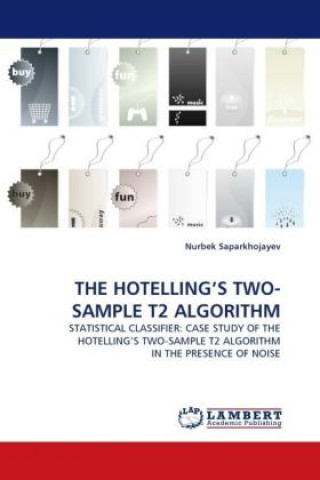
THE HOTELLING S TWO-SAMPLE T2 ALGORITHM
STATISTICAL CLASSIFIER: CASE STUDY OF THE HOTELLING S TWO-SAMPLE T2 ALGORITHM IN THE PRESENCE OF NOISE
 Inglés
 118 b
118 b
Hasta 30 días para devoluciones
Clientes que también han comprado



 /
/
 Libro
Libro
 29.29
€
29.29
€








 /
Tapa blanda
24.69
€
/
Tapa blanda
24.69
€


 /
Tapa blanda
28.69
€
/
Tapa blanda
28.69
€



 /
Tapa blanda
21.79
€
/
Tapa blanda
21.79
€

 /
Tapa blanda
17.09
€
/
Tapa blanda
17.09
€


 /
Tapa blanda
15.89
€
/
Tapa blanda
15.89
€




 /
Tapa blanda
22.59
€
/
Tapa blanda
22.59
€


Matching algorithms or classifiers determine if a previously enrolled instance matches an observed instance based on some rules. They return a decision, which consists of three possible answers: match, non-match, and unclassified. A classifier assigns a class label to a sample and then checks the new instance with a sample one. Or, the classifier is trained with example instances so that it learns what class label should be applied to future unknown instances. Classifiers are based on statistical, probabilistic, and decision rules. In applying classifiers, the most important issue is finding the matching rates. Two important rates are the false acceptance rate (FAR) and the false rejection rate (FRR). In this work, we determine the FAR and FRR for the Hotelling s two-sample T2 algorithm applied to the application of matching electronic fingerprints of radio frequency identification (RFID) tags in the presence of simulated noise. The algorithm is found to be a robust classifier for this application.


Sobre el libro
Inglés

Regale este libro hoy
Es fácil
1 Añadir al carrito y elegir Entregar como regalo en el checkout 2 Le enviaremos un vale 3 El libro llegará a la dirección del destinatarioTambién puede interesarle
 /
Tapa blanda
16.39
€
/
Tapa blanda
16.39
€


 /
Tapa blanda
17.79
€
/
Tapa blanda
17.79
€


 /
Tapa dura
124.59
€
/
Tapa dura
124.59
€



 /
Tapa blanda
8.89
€
/
Tapa blanda
8.89
€


 /
/
 Adobe ePub DRM
126.89
€
Adobe ePub DRM
126.89
€
 /
Tapa blanda
17.29
€
/
Tapa blanda
17.29
€











¡Hola! Soy Libroamiko, tu asesor de libros.
¿Cómo puedo ayudarte?