
 Contacto
 Cómo comprar
Entrega
Guía de compras
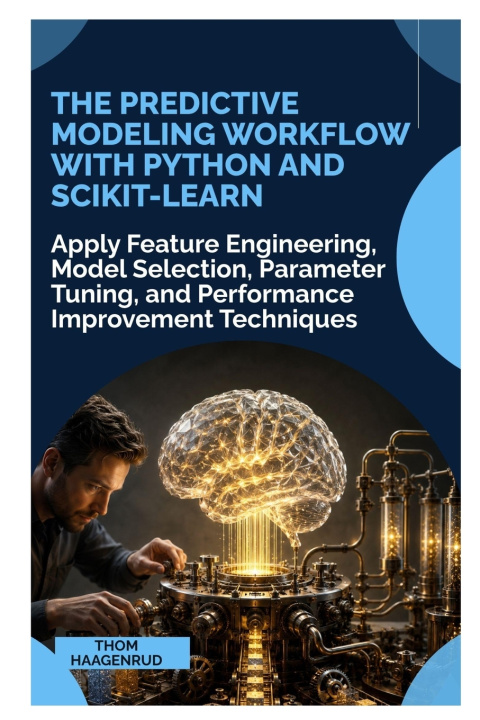
The Predictive Modeling Workflow with Python and Scikit-Learn
Apply Feature Engineering, Model Selection, Parameter Tuning, and Performance Improvement Techniques
 Inglés
 47 b
47 b
 Nuevo
Nuevo
Hasta 30 días para devoluciones

Training a predictive model can take only a few lines of code. Building one you can actually trust requires much more.
The Predictive Modeling Workflow with Python and Scikit-Learn teaches you how to approach structured-data prediction as a complete engineering process, from defining the problem and auditing raw information to comparing algorithms, tuning carefully, evaluating honestly, and preparing the final solution for real use.
Instead of focusing on isolated algorithms, this book shows how all the important pieces fit together. You will learn why validation strategy matters, how leakage creates misleading results, when simpler approaches outperform unnecessary complexity, and how reproducible pipelines make experimentation safer and easier to maintain.
Inside, you will learn how to:
Translate real business questions into clearly defined prediction tasks
Define targets, observation units, prediction timing, and success criteria
Audit structured datasets before training begins
Handle missing values, duplicates, extreme values, groups, and time-dependent observations
Design training, validation, and test splits correctly
Prevent subtle forms of information leakage
Establish meaningful baselines before increasing complexity
Preprocess numerical and categorical variables safely
Build reusable pipelines and column-specific transformations
Create useful ratios, interactions, temporal variables, and custom transformations
Reduce unnecessary dimensions with PCA and other selection methods
Build linear, ridge, lasso, and elastic-net regression solutions
Compare logistic regression, nearest-neighbor methods, and support vector machines
Build decision trees, random forests, extremely randomized trees, and gradient-boosting predictors
Compare competing approaches using consistent cross-validation
Use learning curves and validation curves to diagnose weaknesses
Perform grid search, randomized search, and successive-halving searches efficiently
Avoid overfitting during extensive experimentation
Evaluate regression and classification results using appropriate metrics
Work with confusion matrices, probability calibration, decision thresholds, and error analysis
Inspect variable importance and partial dependence
Improve training speed, prediction latency, throughput, and memory usage
Preserve fitted pipelines for later inference
Document dependencies, assumptions, input requirements, and deployment constraints
A final end-to-end project brings the complete process together, showing how problem definition, dataset auditing, preprocessing, validation, algorithm comparison, search, final evaluation, reproducibility, persistence, and production handoff form one coherent system.
This book is suitable for beginners, students, analysts, career switchers, software developers, and working professionals who want practical competence with structured-data prediction.
Basic Python and familiarity with rows, columns, and DataFrames are helpful, but previous machine-learning experience and advanced mathematics are not required.
If you already know how to call fit() and predict() but want to understand how reliable real-world predictive work is actually organized, this book provides the missing framework.
Move beyond isolated experiments and learn to build prediction workflows that are reproducible, explainable, defensible, and ready for real decisions.


Sobre el libro
Inglés

Regale este libro hoy
Es fácil
1 Añadir al carrito y elegir Entregar como regalo en el checkout 2 Le enviaremos un vale 3 El libro llegará a la dirección del destinatario¡Hola! Soy Libroamiko, tu asesor de libros.
¿Cómo puedo ayudarte?