
 Contacto
 Cómo comprar
Entrega
Guía de compras
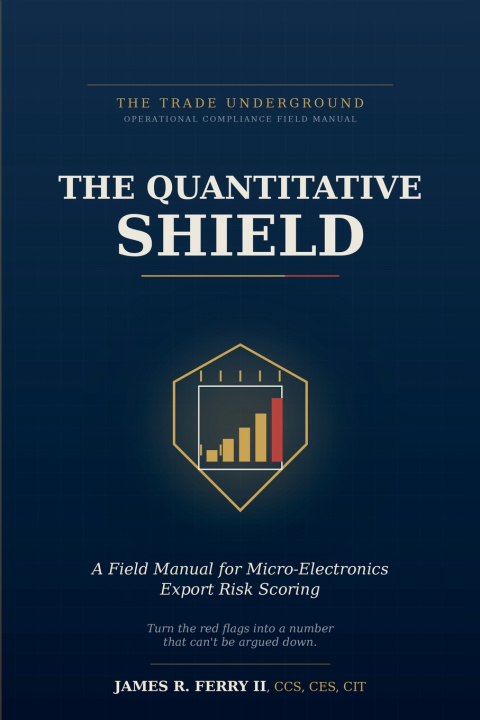
The Quantitative Shield
 Inglés
 66 b
66 b
 Próximamente
 Nuevo
Nuevo
Hasta 30 días para devoluciones

Regulators tell you what to watch for. This tells you how much it's worth.
It's 4:50 on the last Friday of the quarter. A $675,000 order for aerospace-grade programmable chips lands in your queue. The buyer is a company that didn't exist a year ago. The ship-to isn't the buyer - it's a freight forwarder two time zones away. The declared end-use: "educational drone kits." Your screening software runs it and prints one word: CLEAR.
Every one of those details is a textbook BIS Red Flag. And not one of them has a box to check, a number to enter, or a rule that stops the order. You have a text field and a feeling, and the clock is running.
The Quantitative Shield closes that gap. It turns the qualitative BIS "Red Flags" into a single, defensible number - a weighted Transaction Risk Score built from three pillars: Entity, Route, and Product & End-Use risk. Published weights, plain-English 1-5 rubrics, and hard floors that keep a controlled part or a listed-party buyer from ever quietly clearing.
Written by customs and trade specialist James R. Ferry II, it reads like a story - it opens and closes on a single order that passes every automated check and is still a diversion attempt - and works like a manual.
Inside:
- The Transaction Risk Score formula and the reasoning behind every weight
- Three ready-to-use 1-5 scoring rubrics (Entity, Route, Product & End-Use)
- The single-pillar floors that stop a lone critical signal from being averaged away
- A three-tier action matrix wired to system-enforced holds and hard stops
- Reference Python and SQL for ERP integration and a tamper-evident audit trail
- A continuous-calibration routine and a full case-study walkthrough
- A one-page Quick-Reference Scorecard you can pin to the wall
Who it's for:
Export-compliance analysts, trade-compliance managers, and semiconductor and micro-electronics distributors who want the transparency of a scoring model without the black box of enterprise software. Copy the rubrics, tune the weights to your own risk, and put it to work before the goods leave the dock.
A decision-support framework, not legal advice or a licensing determination. Confirm any classification or licensing question with qualified counsel and the current regulations.


Sobre el libro
Inglés

Regale este libro hoy
Es fácil
1 Añadir al carrito y elegir Entregar como regalo en el checkout 2 Le enviaremos un vale 3 El libro llegará a la dirección del destinatario¡Hola! Soy Libroamiko, tu asesor de libros.
¿Cómo puedo ayudarte?