
 Contacto
 Cómo comprar
Entrega
Guía de compras
Virtual Reality
 Inglés
 696 b
696 b
Hasta 30 días para devoluciones
Clientes que también han comprado
















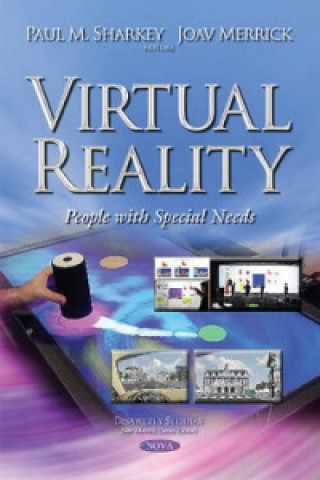
The use of virtual reality for learning, training, and rehabilitation for people with special needs has been on the rise in recent years. Virtual reality allows the user to be trained, to gather information and to perform rehabilitation tasks in the virtual reality space. It allows the user to perform independently, safely, and efficiently, in a combined product of sensory, motor, and cognitive skills. The design, development, and evaluation of such virtual reality environments is a multidisciplinary work, the integration of medicine, physical therapy, occupational therapy, neuroscience, psychology, education, engineering, computer science, and art. In this book we cover a broad range of topics from virtual reality-augmented therapy in the development of cognitive neuroscience perspectives on motor rehabilitation, the potential of virtual environments to improve orientation and mobility skills for people who are blind, virtual reality for people with cerebral palsy, haptic virtual reality technologies for visual impairment and blindness, perception of space and subsequent design changes needed for accessibility, autism spectrum disorder to improving cognitive and intellectual skills via virtual environments in a range of different topics such as mathematical performance or prospective memory.


Sobre el libro
Inglés

Regale este libro hoy
Es fácil
1 Añadir al carrito y elegir Entregar como regalo en el checkout 2 Le enviaremos un vale 3 El libro llegará a la dirección del destinatarioTambién puede interesarle







 /
/
 Tapa blanda
 13.59
€
13.59
€







 /
Tapa blanda
13.49
€
/
Tapa blanda
13.49
€




 /
Tapa blanda
26.29
€
/
Tapa blanda
26.29
€


¡Hola! Soy Libroamiko, tu asesor de libros.
¿Cómo puedo ayudarte?