
 Contacto
 Cómo comprar

Entrega
Guía de compras
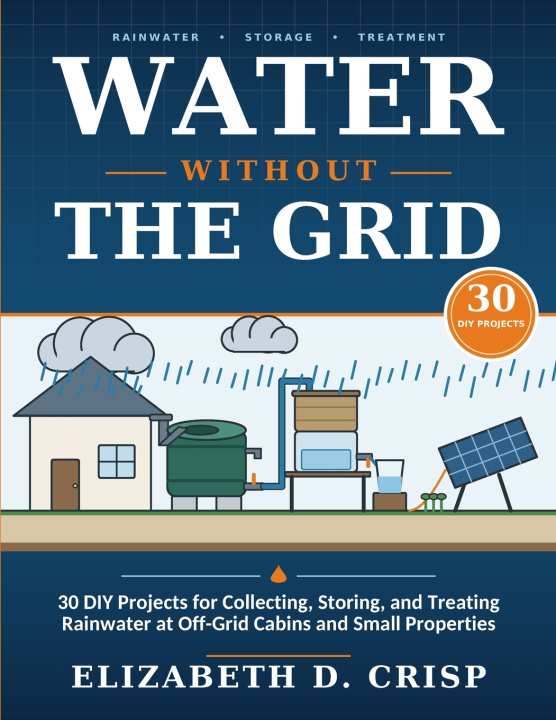
Water Without the Grid
30 DIY Projects for Collecting, Storing, and Treating Rainwater at Off-Grid Cabins and Small Properties
 Inglés
 46 b
 Nuevo
 Entrega en Navidad ▾
Almacenamiento externo
Envío en 9-13 días
Hasta 30 días para devoluciones

A tap that runs dry gives no warning. It simply stops, and the people who feel it first are the ones who live far from a water main.
Many owners of off-grid homes, cabins, and small properties try to solve this with a barrel and a downspout, then meet the real problems. The roof is smaller than they guessed. The tank was sized for the wrong season. A local rule nobody checked forces the build to come down. And over every gallon hangs one question: is this roof water fit for anything beyond the garden?
This book answers those problems in the right order: arithmetic before hardware, then thirty buildable projects that follow the water from gutter to tap, with the limits of every treatment stated plainly.
What you will be able to do
- Measure your catchment from the ground, work out how many gallons a year your roof can deliver, and compare that with what your household uses.
- Size storage for your longest dry stretch, not a yearly average that hides the dry months.
- Set aside the dirtiest first runoff with a standpipe first-flush diverter or a compact bucket flush chamber sized to your roof.
- Build rain barrels, linked barrel chains, and tote-tank manifolds with screened inlets, safe overflows, and level gravel pads.
- Understand what settling, filtering, boiling, and household bleach each do and do not do, so clear water is never mistaken for safe water.
- Keep a source-water log and a laboratory testing plan, and maintain, winterize, and troubleshoot the whole system.
Eight shared skills taught once. Every project opens with its level, time, and result, then gives the reason it works, a materials list, numbered steps with "Check" lines, a troubleshooting table, variations, and a checklist. You will build gravity-fed tap stands, hand pump stations, settling buckets, a two-bucket gravity filter, a hollow-fiber gravity bag stand, a bucket slow sand filter, a boil-and-cool station, a bleach dosing reference card, a low-voltage solar transfer pump, barrel-fed drip irrigation, and soaker beds. Two reference designs, one for a cabin and one for a small homestead, bring the parts together.
Who it is for
Owners of off-grid homes and cabins, homesteaders on small properties, and anyone who wants a water backup that does not depend on the power staying on.
Get your copy, do the arithmetic for your own roof, and begin building a water system you understand well enough to keep working.


Sobre el libro
Inglés
Categorías

Regale este libro hoy
Es fácil
1 Añadir al carrito y elegir Entregar como regalo en el checkout 2 Le enviaremos un vale 3 El libro llegará a la dirección del destinatario¡Hola! Soy Libroamiko, tu asesor de libros.
¿Cómo puedo ayudarte?