
 Contacto
 Cómo comprar
Entrega
Guía de compras
 Inglés
 33 b
33 b
 Nuevo
Nuevo
Hasta 30 días para devoluciones

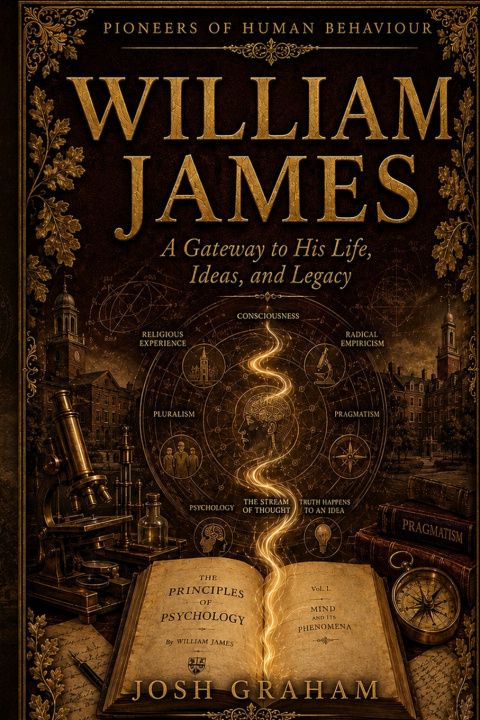
He wrote the founding textbook of American psychology, and near the end of it he told his publisher the thing proved there was no such thing as a science of psychology.
The letter is dated 9 May 1890, twelve years into a book that had consumed him. He called it a loathsome, distended, tumefied, bloated, dropsical mass, testifying to nothing but two facts: that psychology was not a science, and that its author was incapable. Then it went to the printer and reorganised how a century talked about the mind.
Most of what gets repeated about James has been tidied somewhere between the record and the textbook.
The sentence most often put in his mouth is not his. "We are afraid because we run" appears nowhere in the 1884 paper, nor in the chapter of the Principles that reworks it. What he wrote was that we feel sorry because we cry, angry because we strike, afraid because we tremble - and his own example makes running from a bear the cool course a person might take without feeling afraid at all.
The breakdown-and-cure story is a later construction. The familiar sequence - asylum vision, despair, Renouvier, decisive choice, cure - was assembled after his death by his son and his biographer. Only the diary entry of 30 April 1870 is securely dated, and the recovery was gradual and never total.
And the hardest thing in the book is not a theory. In November 1865, on Louis Agassiz's expedition to Brazil, James stood in a room in Manaus where young women were being photographed to prove a racial theory, and wrote the evening down in detail: the white muslin, the jewellery, the flowers in their hair, the smell of priprioca. Nothing in the accessible record shows him objecting. A man who would spend the rest of his life insisting that every person's experience be taken on its own terms spent an evening watching that principle denied, and wrote down the flowers.
Inside:
- The stream of consciousness, habit as the flywheel of society, and self-regard as a fraction of success over pretension - his ideas in his own terms, with the boundary he drew around each
- Mary Whiton Calkins: an unsanctioned examination on 28 May 1895, six Harvard examiners unanimous, and a doctorate the university refused because she was a woman and has refused ever since, including after her death
- The room in Manaus, staged from his own diary of 10 November 1865, with the judgement weighed in a later chapter rather than pronounced over his shoulder
- What Walter Cannon demolished in 1927, what survived it, and what modern work on the body and emotion actually revived
- Bill Wilson and Alcoholics Anonymous, with the sequence corrected: the copy of The Varieties of Religious Experience arrived the day after the white light
- The teaching room at Harvard that is not America's first psychology laboratory, and the three dates its own historians give it
- The remark most quoted against him - that it is literature, it is beautiful, but it is not psychology - attributed to Wilhelm Wundt, though no such statement survives over Wundt's own name
Also here: Edward Thorndike's experimental chicks, housed in James's own cellar because animals were barred from the Harvard laboratory; Gertrude Stein, who wrote forty years later that the lasting impression of her Radcliffe years came through him; the medical degree he took in 1869 and never used; and the afternoon at Chocorua when he sank into a chair beside the fire and sobbed, "It's so good to get home!"
Written for the general reader, not the seminar room. Verified sources, no invented scenes, and the criticism given its due.
Part of Pioneers of Human Behaviour - gateway books on the minds that shaped us.


Sobre el libro
Inglés

Regale este libro hoy
Es fácil
1 Añadir al carrito y elegir Entregar como regalo en el checkout 2 Le enviaremos un vale 3 El libro llegará a la dirección del destinatario¡Hola! Soy Libroamiko, tu asesor de libros.
¿Cómo puedo ayudarte?